Help Center
Grading and feedback

Grading a whole class at once

Once validation satisfies you, grade the whole set in one pass, then review the results.

Updated September 12, 2026

Grading one paper at a time is how you validate the grader. Once you are confident, you can grade the whole class in a single pass and then review, instead of opening each paper yourself.

Unlocking it

Bulk grading opens when you answer Comfortable with this grader? at the bottom of the Validate step. See Validating the grader against your grading for what has to be true before you can answer it. Until then, you grade and confirm papers individually.

Running it

The button above the submission list says what it will do. With nothing selected it reads Grade N ungraded and grades every paper that has not been graded yet. Tick some rows first and it reads Grade N selected and grades only those. To re-grade papers that already carry a grade, use the caret beside the button.
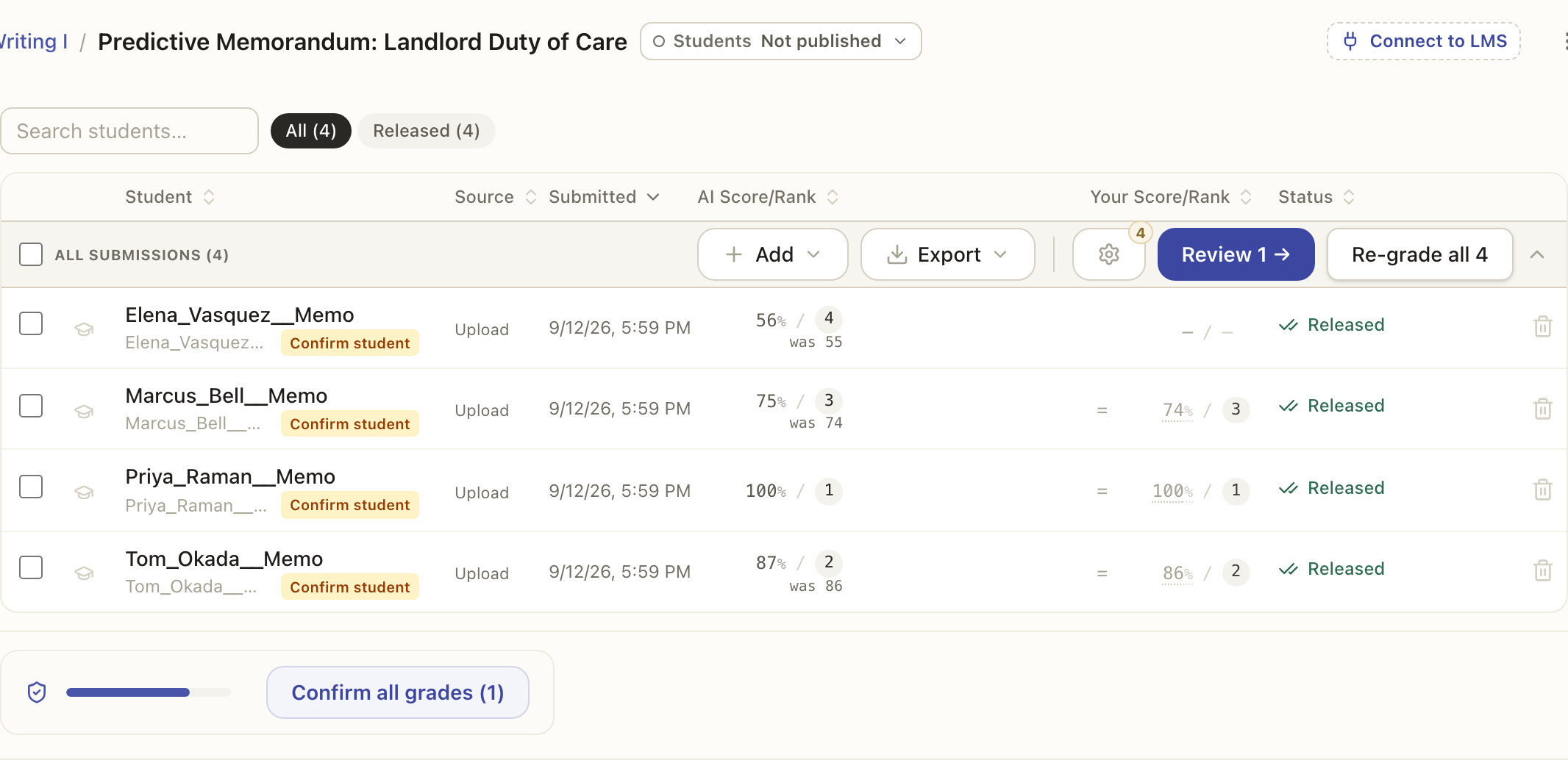
The Grade step: the paper list with its status chips, and the bar that grades, reviews and re-grades the set.

Either way the whole set is graded together in one run: every paper is graded at the same time, so a full stack finishes much faster than opening and grading each one on its own. You can watch its progress, and stop it if you need to.

You will see one confirmation before the run starts, and only when there is something to say: what it will cost in credits, or what is still unvalidated. Tick Don't ask again on it and future runs start on the click. A run that would go past your credit balance still asks, and you can turn the confirmation back on in Settings, under Grading.

You still decide

Bulk grading proposes scores for the whole class at once, but it does not release anything. When it finishes, you review the results, adjust anything that needs it, and only then release. Grading at scale and releasing are still separate steps, so nothing reaches a student until you say so.

Was this helpful?

Keep reading

  • Uploading papers — Which files work, how a stack is matched to students, and what each status in the paper list means.
  • How grading works — The assistant proposes; you decide. How scores are made and how you stay in control.
  • Scoring a criterion with rules — When a criterion is a checklist rather than a judgment: Binary and Count rules, adding up or deducting, and what the rail shows.
  • Validating the grader against your grading — Run a few papers you have already graded on the Validate step, so the assistant learns how you actually score before it grades the class.
  • Reviewing and adjusting the feedback — Adopt the assistant's observations you agree with, dismiss the rest, and write your own.
  • Reading the grade rail — How much of the AI's read to show, where each score came from, what the look-fors say, and how to filter the margin.
  • Marking up a paper — The grading page: the pen tools, your own comments, suggested rewrites, what students see, and undo.
  • The assistant, and talking to it — The three places you can ask the assistant for help, what each one knows, and how to dictate instead of type.
  • When a grade needs a second try — Stopping a run, re-grading a paper, what a failed or incomplete grade means, and what happens during an AI outage.
  • Your comment library — Every comment you write collects in one library: browse it while grading, insert with a keystroke, and bring in the comments you wrote before.
  • Comment suggestions in your own voice — As you write a margin comment, LawGrader suggests the rest of it, drawn from the comments you have written before.
  • Giving the grader supporting docs — Hand the assistant the documents you grade against: the set reading, a reference text, a style guide.