When the assistant grades, it does more than propose a score: it leaves observations in the margin, tied to specific passages. Reviewing them is where you shape the feedback a student actually receives.
Two kinds of margin notes
- Observations are the assistant's. Each one points at a passage and makes a point about it. You adopt the ones that help and dismiss the ones that do not.
- Comments are yours. You write them directly on the work, anchored to whatever passage you select.
What lands on the student's report
By default every observation the assistant leaves starts on the student's report, alongside your own comments. You curate down rather than up: hide anything you would rather the student not see using the eye icon on its card, or dismiss it outright to remove it. The eye at the top of the Comments column does the same thing to every comment showing at once, so you can filter to a group and take all of it off the report in one click. Nothing is sent until you release the work, so there is no rush to it.
If you would rather start from an empty report and add each note yourself, turn off AI comments on the student report by default in Settings, under Grading. Either way a dismissed observation is gone.
Putting your name on one
An observation you agree with can carry your thumbs up. Click the thumb at the left of its card and the student sees your initials beside the comment on their report, next to the mark that says LawGrader wrote it.
It is a mark and nothing more. The comment stays LawGrader's, it is not added to your comment library, and no score moves. If you want the comment to be yours, edit it: saving an edit makes you its author, and your name replaces LawGrader's everywhere it appears.
A thumbs up also puts the comment on the student's report if it was hidden, since a mark the student cannot see does nothing. The eye still works afterwards. Taking a thumbs up back leaves the comment where it is; only the mark goes.
Comments with no thumbs up mean nothing either way. There is no way for a student to read one as something you disagreed with, because nothing on their report says you weighed it at all.
Saying why
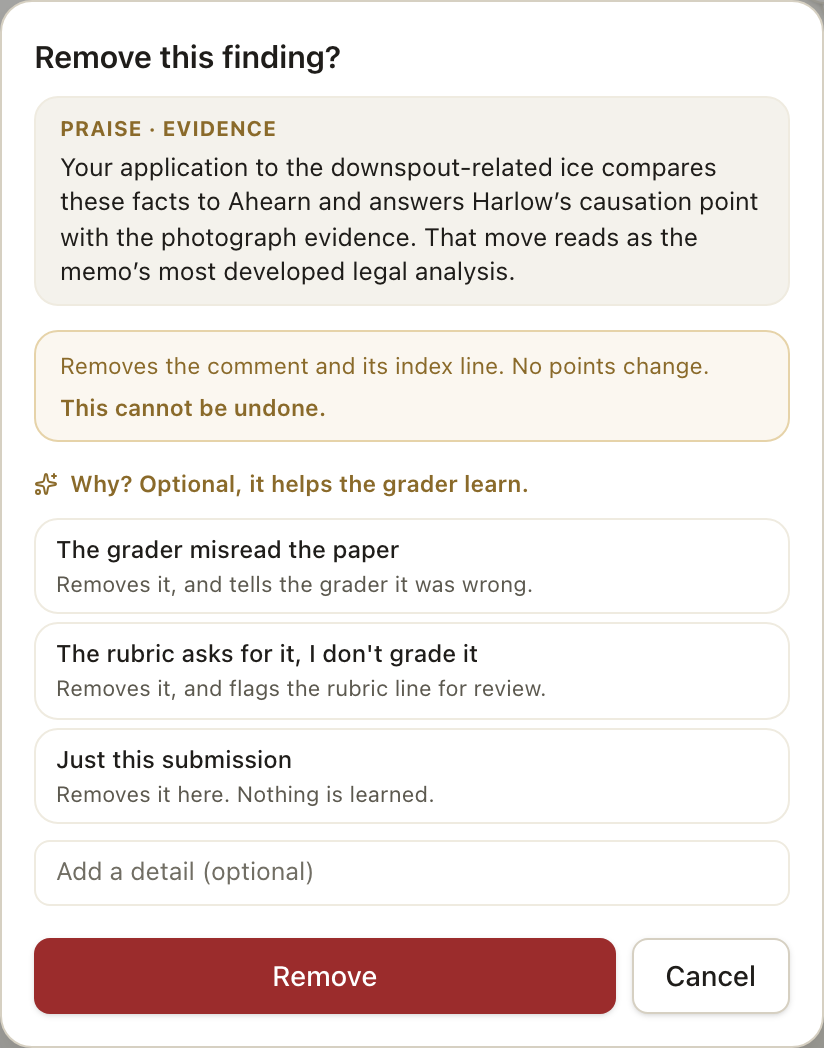
Removing an observation that cost points opens a short question first: Why? It is optional, and it helps the grader learn. The grader misread the paper removes it and tells the grader it was wrong. Real, but too small to cost points keeps the observation as a no-cost note. The rubric asks for it, I don't grade it records an objection to the rubric rather than to the reading. Just this submission removes it here and teaches nothing. An observation with no points behind it offers only the first and last.
Anchored to the work
Both kinds attach to specific text, so a student sees feedback right next to the sentence it is about, not a vague summary at the end. A note that is not about one passage in particular lives in a document-level deck instead, and prints on the report's cover page rather than in the margin.
Occasionally a note that is about a passage still ends up there: if its quote cannot be located on the page, there is no margin for it to sit in. In the margin its eye turns brass rather than blue, and hovering it tells you it will print as a cover note. It still reaches the student either way, so nothing you keep is lost.
Grading with a TA or a co-teacher
Anyone on the teaching team can open any paper. The first mark you make on one, a score, a comment, a highlight, holds it for you: a small Locked by you tag appears next to the student's name, and anyone else who opens that paper can read it but not change it, with a banner naming you. It lets go on its own when you confirm the grade, leave the paper, or stop marking for a few minutes. Confirm all and Release skip a paper someone else is grading right now and tell you which. If a colleague opened a paper and walked away, the banner turns brass after a couple of minutes and the professor or a co-teacher can Take over. On the assignment page, the Confirmed by column shows who signed each paper off, and shows the lock with their name while someone is on it. If you teach a class on your own, there is no tag: nobody else can open your papers, so there is nothing to hold them against.
Staying in control
This is the heart of staying in charge of the grade: the assistant surfaces a lot of concrete, passage-level observations quickly, and you curate them into the feedback you actually stand behind. Adopt generously, dismiss freely, and add your own voice where it matters. See How grading works for how observations relate to the score.