Most criteria are judgments: the assistant reads the paper and places it on a level. Some are not. "Every source is cited in the required style", "no more than three missing citations", "a headline, a byline and a pull quote": these are things you check, one by one, and the score follows from what you found. A criterion scored by rules is built for those.
Setting one up
Open Set up criterion from the criterion's row in the rubric builder. Under Scored by, choose Rules instead of Look-fors. The header then shows two more choices:
- Type: Binary (a rule is met or not) or Count (a rule fires once per occurrence, each occurrence worth a rate, up to a cap).
- Direction: Add up (the student starts at zero and earns each rule's points) or Deduct (the student starts at full marks and each rule that fires takes points off, never below zero).
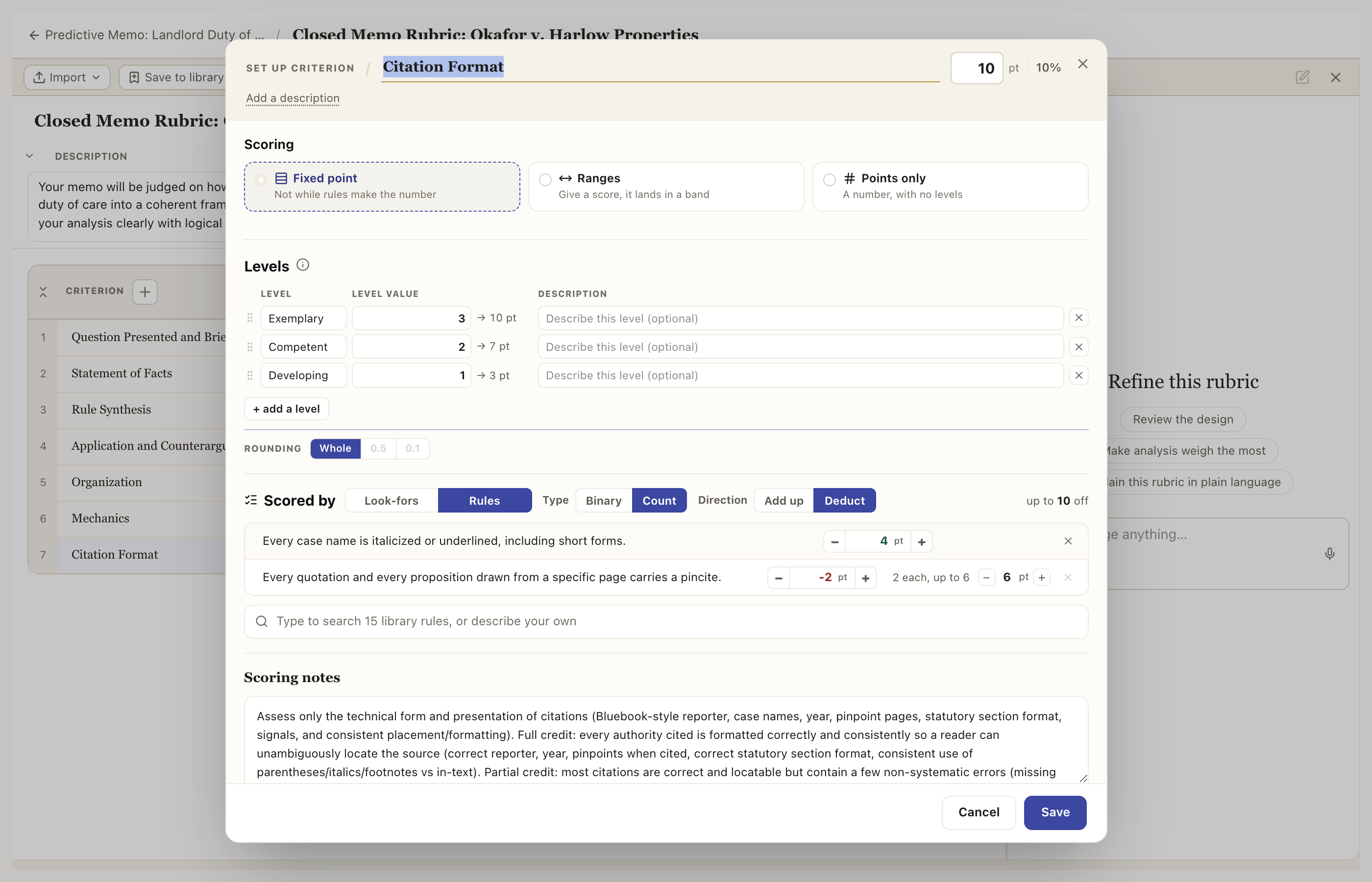
Each rule is a row: the check in plain words, and its worth. On a Count rule the worth is a rate with a cap ("2 each, up to 6"). The right edge totals what the list can move ("up to 10 off"). Type a rule in the box under the list, or pick one from the library of common checks.
Switching Type or Direction is a conversion, and the modal says what it will cost before you confirm: a Binary list turned into a Count list needs rates and caps, and a Deduct list turned into Add up flips every sign. Under a Fixed point, Ranges or Points only criterion, rules are optional and only adjust a score the criterion already has; under Rules scoring they are the score, so the criterion's worth is their sum (or, deducting, the base they take from). See Building a rubric for the rest of the modal.
What the grader does with it
On a rules-scored criterion the assistant does not pick a level. For each rule it returns a verdict, a one-line reason, and the passage it is looking at, quoted word for word. That is all it is asked for, so there is nothing to second-guess beyond "did this fire, and where".
What the rail shows
On the grade page the criterion's card opens a Rules drawer instead of a ladder, and the caption names your setup in the modal's own words: "Binary rules, adding up from 0 · whole points, a partial earns half", or "Count rules, deducting from 10 · charged per occurrence, up to each cap".
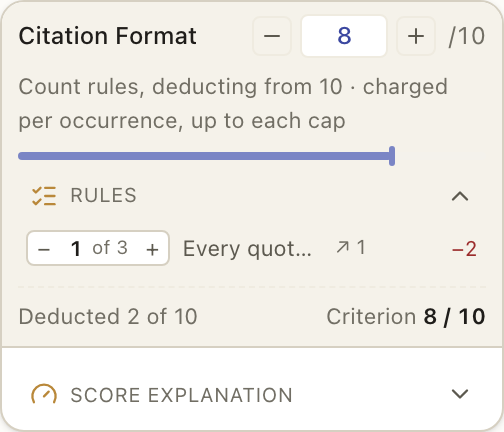
- Each rule is a row with its mark. A Binary rule has a mark you set to met, partial or missing; a Count rule has a stepper (1 of 3) that turns red at its cap.
- The ↗ beside a row jumps to the margin comment the grader left for it, so you can see the passage it counted.
- The foot states the arithmetic once: Deducted 2 of 10 · Criterion 8 / 10.
- Change any mark and the criterion score follows. Your marks win over the grader's; nothing is recomputed behind your back.
A partial on a Binary rule earns or takes half the rule's worth, snapped to the criterion's rounding (whole points, halves or tenths, set in the modal). It is offered only when half is neither zero nor the whole.
Where rules do not apply
Judgment criteria (argument quality, organization, voice) belong on levels, not rules; a checklist cannot see excellence, only compliance. A good rubric usually has both: a few rules-scored rows for the mechanical requirements, and levels for everything that takes reading.